EMI Planning Strategy for Salaried Employees in 2026
- EMI Planning Strategy for Salaried Employees in 2026: A Practical & Smart Guide
- Why EMI Planning Is Crucial in 2026
- What Exactly Is an EMI and Why It Matters
- Ideal EMI Percentage of Salary in 2026
- Step-by-Step EMI Planning Strategy for Salaried People
- EMI Planning Based on Salary Levels
- How Proper EMI Planning Improves Credit Score
- Common EMI Mistakes to Avoid in 2026
- EMI Planning Checklist for Salaried Employees
- Frequently Asked Questions
- Final Words
EMI Planning Strategy for Salaried Employees in 2026: A Practical & Smart Guide
In 2026, managing EMIs has become one of the most important financial skills for salaried individuals in India. With rising living costs, changing interest rates, and increasing access to instant loans, poor EMI planning can quickly lead to financial pressure—even for people earning good salaries.
This guide explains how salaried employees can plan EMIs intelligently in 2026, using simple rules, real-life examples, and budgeting logic that actually works.
Why EMI Planning Is Crucial in 2026
Most salary earners believe that a higher income automatically means financial comfort. In reality, financial stress usually comes from poor EMI decisions, not low salary.
In 2026:
-
Many loans are linked to floating interest rates
-
Monthly expenses are rising steadily
-
People are taking multiple EMIs unknowingly
-
Job changes and income gaps are more common
Without a clear EMI strategy, even one unexpected expense can disrupt your entire monthly budget.
What Exactly Is an EMI and Why It Matters
An EMI (Equated Monthly Installment) is the fixed monthly payment you make toward a loan. It includes:
-
Repayment of principal
-
Interest charged by the lender
Your EMI amount depends on:
-
Loan amount
-
Interest rate
-
Loan tenure
A poorly chosen EMI can reduce savings, limit lifestyle flexibility, and increase long-term interest burden.
Ideal EMI Percentage of Salary in 2026
One of the most searched questions by salaried employees is:
How much EMI is safe for my salary?
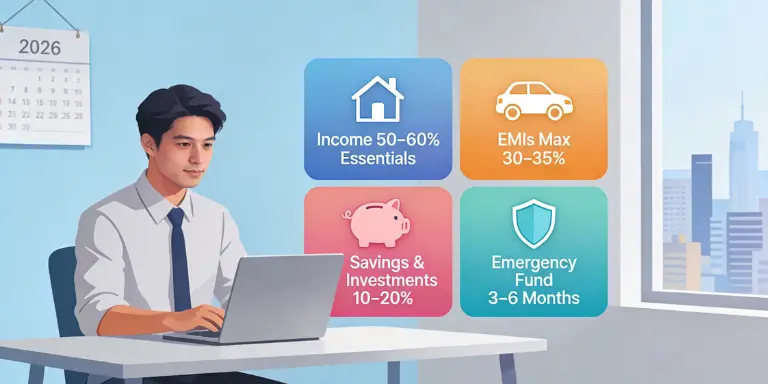
Practical EMI Rule
-
30–40% of monthly take-home salary → financially safe
-
Above 50% → high risk and stressful
Example:
If your monthly take-home salary is ₹60,000:
-
Safe EMI range: ₹18,000 to ₹24,000
-
Risk zone: ₹30,000 and above
This limit ensures you still have room for savings, emergencies, and daily expenses.
Step-by-Step EMI Planning Strategy for Salaried People
Step 1: Calculate Your Real Monthly Income
Do not use your CTC for EMI planning.
Use:
-
Salary credited to bank account
-
Stable monthly allowances
Avoid counting:
-
Annual bonuses
-
Variable incentives
-
One-time payments
This gives a realistic base for EMI decisions.
Step 2: Fix Your Monthly Essentials First
Before deciding any EMI, list essential expenses such as:
-
Rent or housing costs
-
Groceries and utilities
-
School fees
-
Insurance premiums
-
Medical expenses
-
Daily commuting
If these are not secured first, EMI planning will fail.
Step 3: Set an EMI Cap Based on Budgeting
A simple and effective budgeting structure:
-
Essentials: 50%
-
Lifestyle spending: 30%
-
Savings and investments: 20%
Your total EMIs should fit within the essentials portion, without disturbing savings.
Step 4: Always Calculate EMI Before Taking a Loan
Never accept a loan offer without checking:
-
Monthly EMI
-
Total interest payable
-
Tenure flexibility
An EMI calculator helps you:
-
Compare loan options
-
Adjust tenure for affordability
-
Understand long-term cost
Calculate first. Apply later.
Step 5: Choose Tenure Carefully, Not Emotionally
Longer tenure reduces EMI but increases total interest paid.
Shorter tenure increases EMI but saves money overall.
Smart approach for 2026:
-
Choose a comfortable EMI
-
Plan future prepayments to reduce tenure gradually
Step 6: Align EMI Planning With Salary Growth
Most salaried employees receive increments every year. EMI planning should account for this.
Effective strategy:
-
Keep EMI manageable initially
-
Use future increments for part-payments
-
Reduce loan duration instead of upgrading lifestyle immediately
This approach saves large interest amounts over time.
Step 7: Build an Emergency Buffer Before Any EMI
Before starting or increasing EMIs, ensure:
-
At least 3 to 6 months of expenses saved
Without an emergency fund:
-
Salary delay or job loss can cause EMI defaults
-
Credit score can suffer badly
Step 8: Avoid High-Interest EMIs
Be cautious with:
-
Buy-now-pay-later schemes
These usually have high interest and silently reduce monthly cash flow.
Priority should be:
-
Close high-interest loans first
-
Limit the number of active EMIs
-
Avoid lifestyle-based EMIs
EMI Planning Based on Salary Levels
Salary ₹30,000–₹45,000
-
Keep EMIs minimal
-
Avoid personal loans unless urgent
-
EMI limit: 30%
Salary ₹50,000–₹80,000
-
Home loan possible with strict planning
-
Avoid overlapping EMIs
-
Maintain emergency savings
Salary ₹1,00,000 and above
-
Focus on loan prepayment
-
Reduce tenure aggressively
-
Avoid lifestyle inflation
How Proper EMI Planning Improves Credit Score
Well-planned EMIs result in:
-
Timely payments
-
Lower credit card utilization
-
Better loan eligibility in future
Missed or delayed EMIs can reduce credit scores significantly and affect future borrowing ability.
Common EMI Mistakes to Avoid in 2026
-
Taking loan based on maximum eligibility
-
Ignoring future interest rate changes
-
Choosing long tenure without prepayment plan
-
Running multiple EMIs together
-
Using instant loans for non-essential expenses
-
Not maintaining emergency savings
EMI Planning Checklist for Salaried Employees
-
EMI below 40% of salary
-
Emergency fund ready
-
EMI calculated before loan approval
-
Tenure balanced with interest savings
-
Prepayment plan in place
-
Credit score monitored regularly
Frequently Asked Questions
What is the safest EMI percentage of salary?
30–40% of monthly take-home income is considered safe.
Should I reduce EMI or reduce loan tenure?
Reducing tenure saves more interest; reducing EMI offers short-term comfort. Choose based on cash flow.
Is it risky to take multiple EMIs?
Yes, if total EMI exceeds safe limits or income is unstable.
Can EMI planning help long-term savings?
Yes. Proper EMI planning protects savings and improves financial stability.
Final Words
In 2026, financial stability depends more on how you manage EMIs than how much you earn.
Subscribe to our newsletter
Get the latest financial tips and calculator updates delivered straight to your inbox.