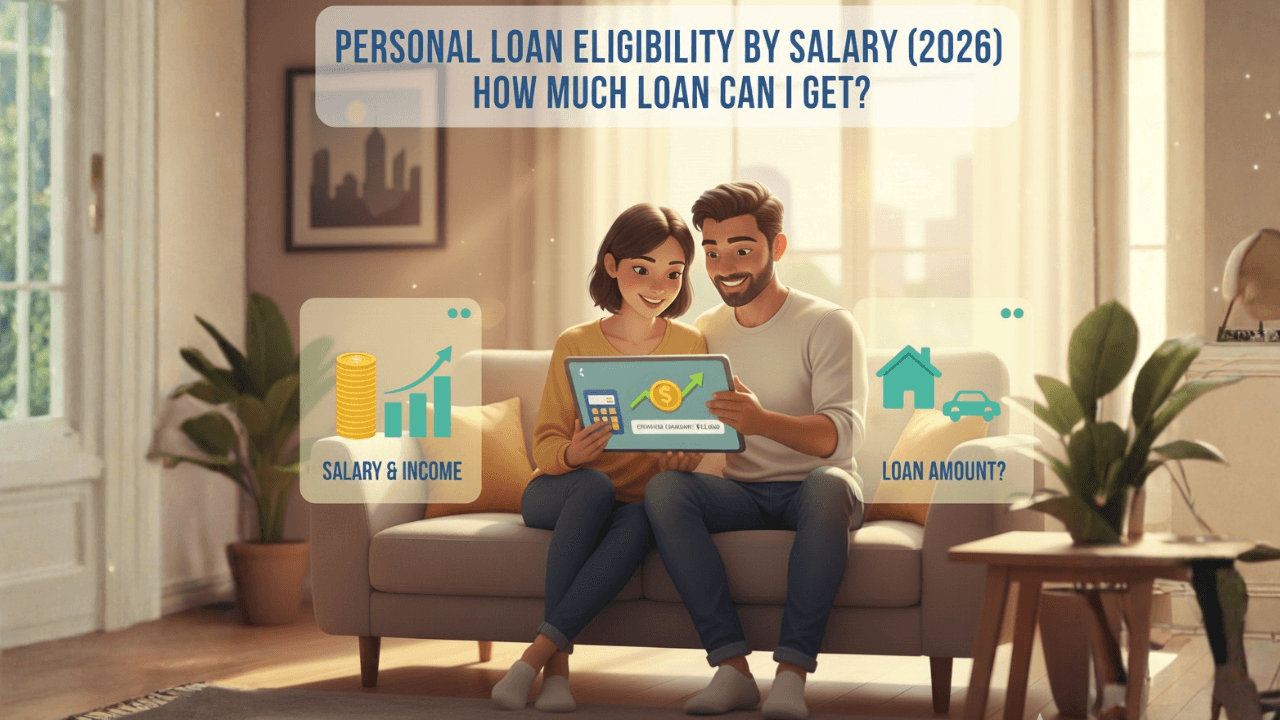
Personal Loan Eligibility by Salary (2026): How Much Loan Can I Get?
- What Is Personal Loan Eligibility?
- How Do Banks Calculate Personal Loan Eligibility by Salary?
- 1. Income Multiplier Method
- 2. EMI Affordability Method
- Personal Loan Eligibility by Salary – 2026 Table (India)
- How Much Personal Loan Can I Get on ₹30,000 Salary?
- How Much EMI Is Safe Based on Salary?
- Factors That Affect Personal Loan Eligibility
- 1. Credit Score (CIBIL)
- 2. Existing EMIs
- 3. Job Type
- 4. Age
- 5. Employer and City
- Personal Loan Eligibility for Self-Employed (2026)
- Why Use a Personal Loan Eligibility Calculator?
- How to Increase Personal Loan Eligibility
- Salaried vs Self-Employed Personal Loan Eligibility
- Common Mistakes to Avoid
- FAQs – Personal Loan Eligibility by Salary (2026)
- How much personal loan can I get on ₹25,000 salary?
- What is the minimum salary required for a personal loan in India?
- Does checking personal loan eligibility affect CIBIL score?
- Can I get a personal loan with a low salary?
- Is personal loan eligibility same for all banks?
- Can I get a personal loan without a salary slip?
- What is the maximum EMI allowed by banks?
Are you planning to take a personal loan in 2026 and wondering how much loan you can get based on your salary?
You are not alone.
Every month, lakhs of Indians search queries like:
-
How much personal loan can I get on 30,000 salary
-
Personal loan eligibility by salary
-
How much EMI can I afford
-
Personal loan eligibility calculator
This guide explains everything in simple words — with salary-wise eligibility tables, bank rules, EMI examples, and FAQs to help you plan safely.
What Is Personal Loan Eligibility?
Personal loan eligibility is the maximum loan amount a bank or NBFC is willing to give you based on factors like:
-
Monthly salary or income
-
Existing EMIs
-
Job type and stability
-
Age and location
Among all these, salary is the most important factor.
How Do Banks Calculate Personal Loan Eligibility by Salary?
Most banks in India use two common methods.
1. Income Multiplier Method
Banks multiply your net monthly salary by a fixed number.
Formula:
Loan Eligibility = Monthly Salary × Multiplier
Typical multiplier range in India (2026):
10× to 24×
2. EMI Affordability Method
Banks ensure your total EMIs do not exceed 40%–50% of your monthly income.
This protects borrowers from over-borrowing.
Personal Loan Eligibility by Salary – 2026 Table (India)
| Monthly Salary | Approx Loan Eligibility |
|---|---|
| ₹20,000 | ₹2,00,000 – ₹4,00,000 |
| ₹25,000 | ₹2,50,000 – ₹5,00,000 |
| ₹30,000 | ₹3,00,000 – ₹6,00,000 |
| ₹35,000 | ₹3,50,000 – ₹7,00,000 |
| ₹40,000 | ₹4,00,000 – ₹8,00,000 |
| ₹50,000 | ₹5,00,000 – ₹10,00,000 |
| ₹60,000 | ₹6,00,000 – ₹12,00,000 |
| ₹75,000 | ₹8,00,000 – ₹15,00,000 |
| ₹1,00,000 | ₹10,00,000 – ₹20,00,000 |
Actual eligibility depends on credit score, existing EMIs, and bank policy.
How Much Personal Loan Can I Get on ₹30,000 Salary?
This is one of the most searched questions in India.
Example:
Monthly salary: ₹30,000
Maximum EMI allowed (40%): ₹12,000
Loan tenure: 5 years
Interest rate: 12%
Eligible loan amount: ₹4 to ₹6 lakhs approximately.
Always calculate EMI first using a personal loan EMI calculator to avoid financial stress.
How Much EMI Is Safe Based on Salary?
Financial experts recommend the following limits.
| Salary | Safe EMI Limit |
|---|---|
| ₹20,000 | ₹6,000 – ₹8,000 |
| ₹30,000 | ₹10,000 – ₹12,000 |
| ₹40,000 | ₹14,000 – ₹16,000 |
| ₹50,000 | ₹18,000 – ₹20,000 |
| ₹1,00,000 | ₹35,000 – ₹40,000 |
Keeping EMI within limits helps avoid defaults, maintain a good CIBIL score, and reduce financial stress.
Factors That Affect Personal Loan Eligibility
1. Credit Score (CIBIL)
-
750 and above: Best eligibility and low interest
-
650–749: Average eligibility
-
Below 650: Lower approval chances
2. Existing EMIs
If you already have home loan, car loan, or credit card EMIs, your new loan eligibility reduces.
3. Job Type
Government and PSU employees generally get higher eligibility.
Private salaried employees get standard eligibility.
Self-employed eligibility depends on income proof.
4. Age
Ideal age range is 21 to 55 years.
Younger borrowers get longer tenure options.
5. Employer and City
Tier-1 cities and reputed companies receive better eligibility.
Personal Loan Eligibility for Self-Employed (2026)
Self-employed professionals such as freelancers, business owners, and consultants are evaluated based on:
-
Last 2–3 years ITR
-
Business stability
-
Bank statements
Income consistency matters more than salary amount.
Why Use a Personal Loan Eligibility Calculator?
Instead of guessing, using a calculator helps you:
-
Check EMI instantly
-
Choose a safe tenure
-
Avoid loan rejection
Calculator-based planning increases approval chances.
How to Increase Personal Loan Eligibility
You can improve eligibility by:
-
Closing small loans before applying
-
Reducing credit card usage
-
Improving CIBIL score above 750
-
Choosing longer tenure to reduce EMI
-
Applying jointly where allowed
Salaried vs Self-Employed Personal Loan Eligibility
| Criteria | Salaried | Self-Employed |
|---|---|---|
| Income proof | Salary slips | ITR and bank statements |
| Approval speed | Fast | Moderate |
| Interest rate | Lower | Slightly higher |
| Approval ease | Easier | Document-based |
Common Mistakes to Avoid
-
Applying to multiple banks at once
-
Ignoring EMI affordability
-
Not checking CIBIL score
-
Taking maximum eligible loan unnecessarily
Eligibility does not mean affordability.
FAQs – Personal Loan Eligibility by Salary (2026)
How much personal loan can I get on ₹25,000 salary?
Approximately ₹2.5 to ₹5 lakhs, depending on EMIs and credit score.
What is the minimum salary required for a personal loan in India?
Most banks require ₹15,000 to ₹20,000 monthly income.
Does checking personal loan eligibility affect CIBIL score?
No. Eligibility checks do not affect your CIBIL score unless you submit a loan application.
Can I get a personal loan with a low salary?
Yes, but the loan amount will be limited and interest rates may be higher.
Is personal loan eligibility same for all banks?
No. Each bank follows different eligibility rules and multipliers.
Can I get a personal loan without a salary slip?
Yes. Self-employed applicants can apply using ITR and bank statements.
What is the maximum EMI allowed by banks?
Usually 40% to 50% of monthly income.
Final Words
Understanding your personal loan eligibility by salary helps you borrow responsibly, avoid EMI stress, and stay financially secure.
Before applying, always:
-
Check eligibility
-
Calculate EMI
-
Compare loan options
This ensures smooth approval and stress-free repayment.
Subscribe to our newsletter
Get the latest financial tips and calculator updates delivered straight to your inbox.