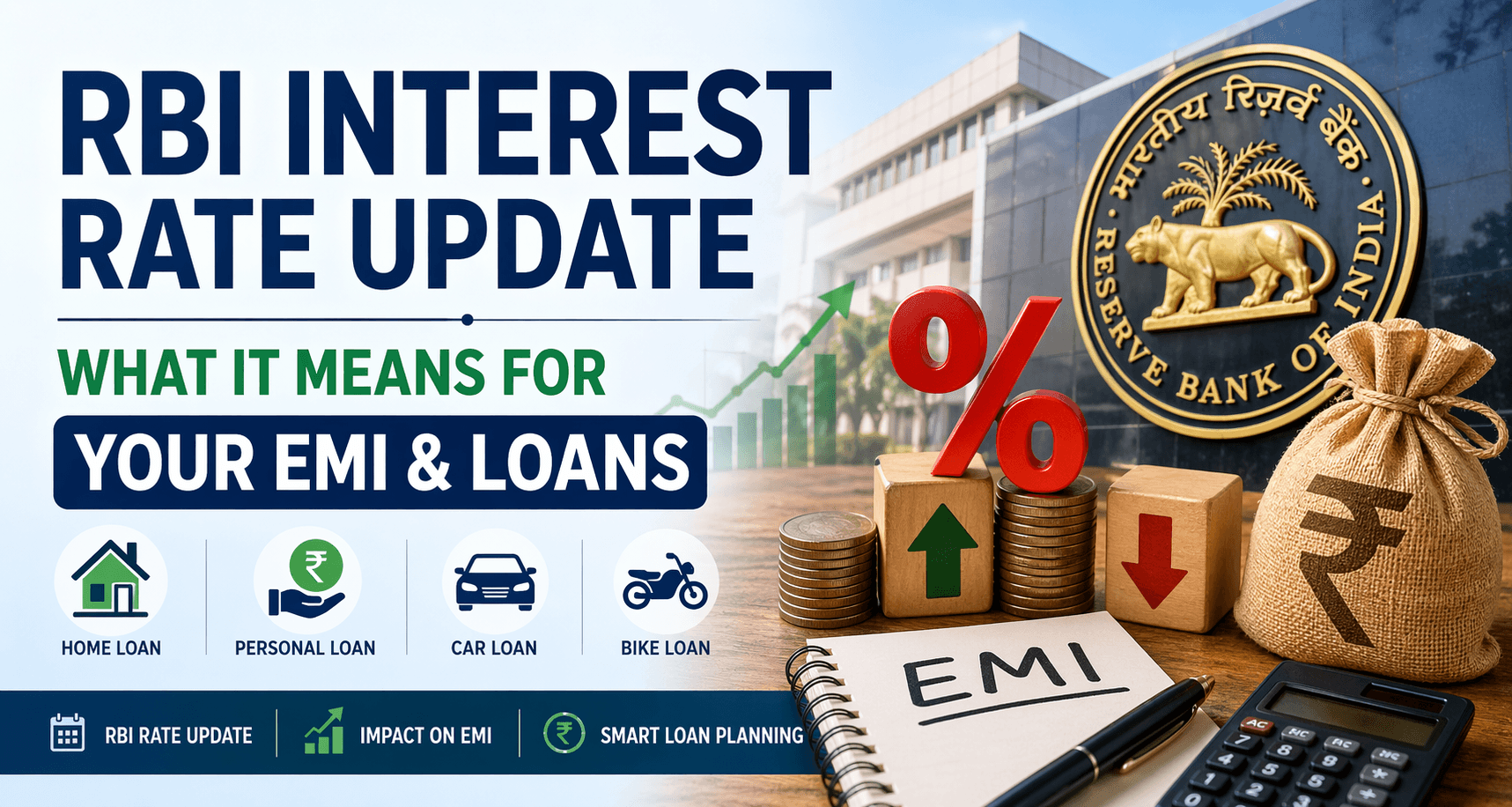
RBI Policy Impact on Home Loans, Personal Loans & EMIs Explained .
- Why RBI policy decisions matter to every loan borrower
- Understanding RBI’s role in simple terms
- Key RBI policy tools that influence loan EMIs
- Repo rate: the most important number for borrowers
- Reverse repo rate: liquidity control
- Cash Reserve Ratio (CRR)
- Statutory Liquidity Ratio (SLR)
- How RBI policy directly affects home loan borrowers
- Floating-rate home loans move with RBI decisions
- Example: Home loan EMI impact
- Why some borrowers don’t feel immediate impact
- RBI policy impact on personal loans
- Personal loans react faster than home loans
- Impact on new vs existing personal loan borrowers
- Fixed-rate vs floating-rate loans during RBI policy changes
- Fixed-rate loans
- Floating-rate loans
- How RBI inflation control affects your EMI indirectly
- Step-by-step: How an RBI policy change reaches your EMI
- Should borrowers worry during rising interest rate cycles?
- Smart borrower responses include:
- Role of EMI calculators in understanding RBI impact
- When should borrowers reconsider their loan strategy?
- Benefits of choosing a professional loan advisory or calculation service
- Key benefits include:
- Common RBI policy misconceptions among borrowers
- RBI controls my EMI directly
- Fixed-rate loans never change
- Rate cuts always reduce EMI
- Personal loans don’t depend on RBI
- Frequently Asked Questions (FAQ)
- How often does RBI review interest rates?
- Does every RBI repo rate hike increase my EMI?
- How long after RBI policy does EMI change?
- Is it better to reduce EMI or tenure during rate hikes?
- Can I request my bank to keep EMI same and reduce tenure?
- Do RBI rate cuts immediately reduce home loan EMIs?
- How can I calculate EMI impact after RBI policy changes?
- Are personal loan EMIs more sensitive to RBI policy than home loans?
- Should I refinance my loan after RBI rate hikes?
- Do RBI policies affect loan eligibility?
- Is RBI policy impact same across all banks?
- Final thoughts: RBI policy awareness is borrower power
Why RBI policy decisions matter to every loan borrower
If you are paying a home loan EMI, planning to take a personal loan, or frequently checking an EMI calculator, Reserve Bank of India (RBI) policy decisions directly affect your money—even if you never read an RBI policy statement.
Every time the RBI announces a repo rate change or policy stance, banks quietly adjust interest rates. That adjustment flows down to your monthly EMI, total interest paid, loan tenure, and even loan eligibility.
Many borrowers notice the EMI change first and ask later, “Why did my EMI increase?”
The answer almost always traces back to an RBI policy decision.
This article explains—clearly and practically—how RBI policy affects home loans, personal loans, and EMIs, what borrowers should expect during rate cycles, and how to make informed decisions instead of reacting blindly.
Understanding RBI’s role in simple terms
The Reserve Bank of India is India’s central bank. Its main responsibilities include:
-
Controlling inflation
-
Maintaining economic stability
-
Regulating banks and financial institutions
-
Managing liquidity in the financial system
To do this, RBI uses monetary policy tools, the most important being interest rates.
When RBI changes these rates, banks respond—and borrowers feel the impact.
Key RBI policy tools that influence loan EMIs
Repo rate: the most important number for borrowers
The repo rate is the interest rate at which RBI lends money to commercial banks.
-
When the repo rate increases, borrowing becomes costlier for banks
-
When it decreases, banks get funds more cheaply
Banks pass this cost on to customers by adjusting loan interest rates.
Floating-rate loans, especially home loans, are directly linked to repo rate movements.
Reverse repo rate: liquidity control
The reverse repo rate is the rate at which banks park excess funds with RBI.
While borrowers don’t feel its impact immediately, it influences how much money banks are willing to lend and at what cost.
Cash Reserve Ratio (CRR)
CRR is the percentage of deposits banks must keep with RBI.
-
Higher CRR → less money to lend → higher loan rates
-
Lower CRR → more liquidity → potential rate relief
Statutory Liquidity Ratio (SLR)
SLR dictates how much banks must invest in safe assets like government securities.
This indirectly affects lending capacity and interest rate flexibility.
How RBI policy directly affects home loan borrowers
Floating-rate home loans move with RBI decisions
Most home loans today are repo-linked floating-rate loans. This means:
-
RBI raises repo rate → home loan interest rate increases
-
RBI cuts repo rate → home loan interest rate decreases
This change impacts borrowers in two ways:
-
Higher EMI with same tenure, or
-
Longer tenure with same EMI
Banks usually choose the second option unless the borrower requests otherwise.
Example: Home loan EMI impact
-
Loan amount: ₹50 lakh
-
Tenure: 20 years
-
Interest rate: 8.5%
If RBI raises repo rate and your loan rate increases to 9%:
-
EMI increases by several thousand rupees or
-
Loan tenure extends by 1–3 years
Over time, this can add lakhs of rupees in extra interest.
Why some borrowers don’t feel immediate impact
If your loan is:
-
On a fixed rate
-
Under a temporary interest subvention
-
Recently sanctioned with a rate lock-in
You may see a delayed effect. But once the reset period arrives, RBI policy impact shows up.
RBI policy impact on personal loans
Personal loans react faster than home loans
Personal loans are:
-
Shorter tenure
-
Higher risk for banks
-
Often priced at higher spreads
Because of this, banks adjust personal loan rates quickly after RBI policy changes.
When RBI tightens policy:
-
Personal loan interest rates rise faster than home loans
-
Eligibility criteria become stricter
Impact on new vs existing personal loan borrowers
-
New borrowers face higher interest rates immediately
-
Existing borrowers may see EMI changes at reset dates
In tightening cycles, banks may also:
-
Reduce maximum loan amounts
-
Increase credit score requirements
Fixed-rate vs floating-rate loans during RBI policy changes
Fixed-rate loans
Pros:
-
EMI stability
-
No immediate impact from RBI hikes
Cons:
-
Usually higher initial interest
-
No benefit when RBI cuts rates
Floating-rate loans
Pros:
-
Benefit during rate cuts
-
Lower long-term cost in stable cycles
Cons:
-
EMI uncertainty
-
Budgeting becomes harder
For long-term loans like home loans, floating rates often make sense—but only if borrowers actively monitor policy changes.
How RBI inflation control affects your EMI indirectly
RBI does not raise rates randomly. Its primary target is inflation control.
When inflation rises:
-
Loan EMIs go up
-
Borrowing slows
-
Demand reduces
-
Inflation cools
This means your EMI increase is part of a larger economic balancing act, not a bank-specific decision.
Step-by-step: How an RBI policy change reaches your EMI
-
RBI announces policy decision
-
Repo rate changes
-
Banks adjust external benchmark lending rates (EBLR)
-
Your loan’s interest rate resets
-
EMI or tenure changes
-
Total interest payable increases or decreases
This entire chain can take days or months, depending on your loan terms.
Should borrowers worry during rising interest rate cycles?
Not necessarily—but they should act strategically.
Smart borrower responses include:
-
Reviewing loan statements after each policy cycle
-
Checking whether EMI or tenure has changed
-
Making partial prepayments when possible
-
Comparing refinance options
Blindly ignoring policy cycles often leads to longer loan tenures and higher interest costs.
Role of EMI calculators in understanding RBI impact
An EMI calculator helps borrowers visualize RBI policy impact before it hits their wallet.
By adjusting:
-
Interest rate
-
Loan tenure
-
Prepayment amounts
Borrowers can clearly see:
-
EMI difference
-
Interest savings or losses
-
Best repayment strategy
Tools like Emi Calculator Vipas are especially useful here, as they allow quick scenario comparisons without complex financial knowledge. Used correctly, they help borrowers plan—not panic.
When should borrowers reconsider their loan strategy?
You should reassess your loan if:
-
RBI has increased rates multiple times consecutively
-
Your loan tenure has silently increased
-
You have surplus funds for partial prepayment
-
Your credit profile has improved
These moments often present opportunities to reduce long-term interest burden, even in a high-rate environment.
Benefits of choosing a professional loan advisory or calculation service
While EMI calculators provide clarity, professional financial services add context.
Key benefits include:
-
Personalized loan structuring advice
-
Understanding lender-specific reset policies
-
Guidance on balance transfer timing
-
Accurate cost-benefit analysis beyond EMI
For borrowers with large loans or multiple EMIs, professional input can prevent costly mistakes.
Common RBI policy misconceptions among borrowers
RBI controls my EMI directly
False. RBI controls policy rates. Banks decide loan pricing.
Fixed-rate loans never change
Incorrect. Many fixed-rate loans convert to floating after a few years.
Rate cuts always reduce EMI
Not always. Some banks reduce tenure instead.
Personal loans don’t depend on RBI
They do—often faster than home loans.
Frequently Asked Questions (FAQ)
How often does RBI review interest rates?
RBI reviews monetary policy six times a year through the Monetary Policy Committee (MPC).
Does every RBI repo rate hike increase my EMI?
Only if your loan is floating-rate and linked to repo rate. Fixed-rate loans remain unaffected until reset.
How long after RBI policy does EMI change?
Typically 1–3 months, depending on loan reset cycles and bank policies.
Is it better to reduce EMI or tenure during rate hikes?
Reducing tenure usually saves more interest over time, if affordable.
Can I request my bank to keep EMI same and reduce tenure?
Yes. Most banks allow this upon borrower request.
Do RBI rate cuts immediately reduce home loan EMIs?
Not always. Some banks adjust tenure instead of EMI.
How can I calculate EMI impact after RBI policy changes?
Using an EMI calculator where you can modify interest rate and tenure gives the clearest picture.
Are personal loan EMIs more sensitive to RBI policy than home loans?
Yes. Personal loan rates typically adjust faster and by larger margins.
Should I refinance my loan after RBI rate hikes?
Refinancing makes sense only if the interest rate difference justifies switching costs.
Do RBI policies affect loan eligibility?
Indirectly, yes. Higher rates can reduce eligible loan amounts.
Is RBI policy impact same across all banks?
No. Each bank has different spreads, reset periods, and internal policies.
Final thoughts: RBI policy awareness is borrower power
RBI policy decisions are not just headlines—they shape your monthly cash flow, long-term savings, and financial flexibility.
Borrowers who understand:
-
How policy rates work
-
How banks transmit changes
-
How EMIs are recalculated
…make calmer, smarter decisions—even during uncertain rate cycles.
Instead of reacting to EMI changes after the fact, use policy awareness and simple tools like EMI calculators to stay ahead. Over a 20-year loan, this awareness alone can save lakhs of rupees.
Subscribe to our newsletter
Get the latest financial tips and calculator updates delivered straight to your inbox.