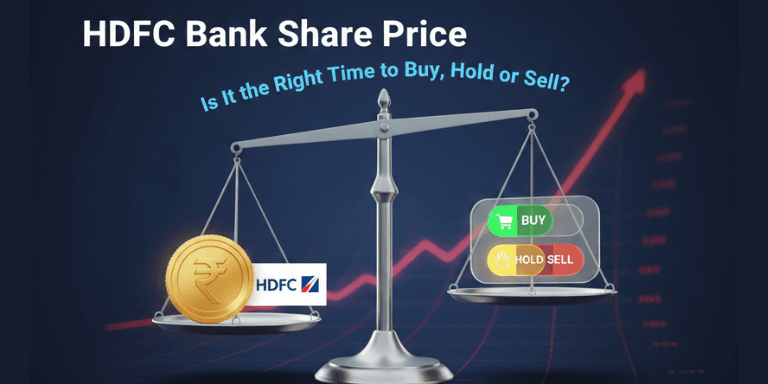
HDFC Bank Share Price: Is It the Right Time to Buy, Hold or Sell?
The HDFC Bank share price is one of the most closely tracked indicators in the Indian stock market. As India’s largest private sector bank by market capitalization, HDFC Bank plays a crucial role not only in the banking system but also in long-term wealth creation for investors.
Whether you are a long-term investor, a short-term trader, or someone comparing equity investment vs fixed EMIs, one question keeps coming up:
Is this the right time to buy, hold, or sell HDFC Bank shares?
In this detailed analysis, we will break down:
-
Current HDFC Bank share price trends
-
Fundamental and financial strength
-
Technical analysis (support & resistance)
-
Growth outlook after the HDFC merger
-
Comparison with fixed-return options like EMIs
-
Buy / Hold / Sell strategy for different investors
HDFC Bank Share Price Overview
HDFC Bank share price movements often reflect:
-
Banking sector health
-
RBI policy decisions
-
Interest rate cycles
-
Credit growth in the Indian economy
Historically, the stock has delivered consistent compounding returns rather than sudden spikes. That makes it ideal for investors who think in 5–10 year horizons, similar to long-term EMI planning for home loans or retirement goals.
Why HDFC Bank Is a Market Favorite
1. Strong Fundamentals
HDFC Bank has built its reputation on:
-
High asset quality
-
Low NPAs compared to peers
-
Strong CASA (Current & Savings Account) ratio
-
Consistent profit growth
This stability is why many investors treat HDFC Bank stock almost like a “financial SIP”, similar to paying monthly EMIs through an EMI calculator.
2. Leadership in Retail Lending
HDFC Bank dominates:
-
Home loans
-
Auto loans
HDFC Bank and the EMI Economy
India is increasingly becoming an EMI-driven economy:
-
Homes bought through home loan EMI calculators
-
Cars financed via auto loan EMIs
-
Smartphones and appliances on no-cost EMI
HDFC Bank benefits directly from this shift.
Why EMI Growth Supports Share Price
-
More loans = higher interest income
-
EMI calculators help customers plan affordability
-
Predictable EMIs improve repayment behavior
In simple terms:
When EMI calculators show affordability, banks like HDFC Bank earn stable income — which supports long-term share price growth.
Fundamental Analysis of HDFC Bank Share Price
Revenue & Profit Growth
HDFC Bank has consistently reported:
-
Rising net interest income
-
Controlled operating expenses
-
Healthy profit margins
Even during economic slowdowns, the bank has managed to stay profitable—unlike many cyclical stocks.
Asset Quality
One of the strongest reasons to hold or buy HDFC Bank shares:
-
Lower bad loans compared to industry average
-
Conservative lending policies
-
Balanced retail + corporate exposure
This makes it a safer investment compared to highly leveraged NBFCs.
Capital Adequacy
HDFC Bank maintains strong capital buffers, allowing it to:
-
Lend more
-
Absorb shocks
-
Expand without dilution
For long-term investors, this is similar to maintaining a buffer fund before committing to long-term EMIs.
Technical Analysis: Buy, Hold or Sell?
Support Levels
Historically, HDFC Bank share price finds strong buying interest at:
-
Long-term moving averages
-
Previous consolidation zones
When the stock approaches these zones, long-term investors often accumulate.
Resistance Levels
Short-term resistance usually appears:
-
Near previous highs
-
During weak market sentiment
Traders may book profits near resistance, while investors continue holding.
Trend Strength
-
Long-term trend: Bullish
-
Short-term trend: Consolidation / range-bound (depends on market cycle)
This makes HDFC Bank ideal for:
-
SIP investing
-
Portfolio stability
Impact of Interest Rates on HDFC Bank Share Price
Interest rates affect both:
-
EMI affordability
-
Bank profitability
When Rates Rise
-
EMIs increase (checked using EMI calculators)
-
Loan growth may slow
-
Banks earn higher interest margins
When Rates Fall
-
EMIs reduce
-
Loan demand increases
-
Volume growth supports profits
HDFC Bank has historically managed both cycles efficiently, making it resilient across interest rate environments.
HDFC Bank Share Price vs Fixed EMI Investments
Many investors ask:
“Should I invest in stocks or stick to predictable EMIs and fixed returns?”
EMI-Based Instruments
-
Fixed monthly outflow
-
Predictable
-
Low risk
-
Limited upside
HDFC Bank Equity Investment
-
Market-linked returns
-
Higher long-term growth potential
-
Volatility in the short term
Smart investors often balance both:
-
Use EMI calculators to manage loans
-
Use stocks like HDFC Bank to beat inflation
Who Should BUY HDFC Bank Shares?
You should consider buying if:
-
You have a 5+ year investment horizon
-
You prefer stable compounding over speculation
-
You want banking exposure with lower risk
-
You already manage EMIs responsibly
Who Should HOLD HDFC Bank Shares?
You should hold if:
-
You already own the stock
-
The business fundamentals remain strong
-
Short-term price movements do not affect your goals
Just like continuing EMIs during market fluctuations, long-term holding rewards patience.
Who Should SELL HDFC Bank Shares?
You may consider selling if:
-
You need liquidity for short-term goals
-
You want to rebalance portfolio exposure
-
Your investment thesis has changed
Selling purely due to short-term volatility is usually not advisable for quality banking stocks.
Future Outlook of HDFC Bank Share Price
Key Growth Drivers
-
Rising digital banking adoption
-
Expanding loan book
-
Growing middle-class EMI demand
-
Strong brand trust
Risks to Watch
-
Sudden spike in NPAs
-
Prolonged economic slowdown
-
Regulatory changes
Overall, analysts continue to view HDFC Bank as a core portfolio stock rather than a trading bet.
FAQs: HDFC Bank Share Price & Investment
Is HDFC Bank a good long-term investment?
Yes, due to strong fundamentals and consistent growth.
Does EMI growth affect HDFC Bank profits?
Yes. Higher EMI-based lending directly improves interest income.
Can I use EMI calculator data for investment planning?
Absolutely. EMI calculators help balance loans while investing surplus in equities.
Is HDFC Bank safer than small finance banks?
Generally yes, due to scale, regulation, and asset quality.
Subscribe to our newsletter
Get the latest financial tips and calculator updates delivered straight to your inbox.